

Store brands go Korean: Ulta, Rossmann and Mercadona order from Seoul
Retailers in Europe and the US now have their own skincare made by Korean factories. What a made-in-Korea store brand gets you, and what it doesn't.
Reported by Seoul Economic Daily, with BeautyDump's US prices and take.
Published
We may earn a commission from retailer links. How we work
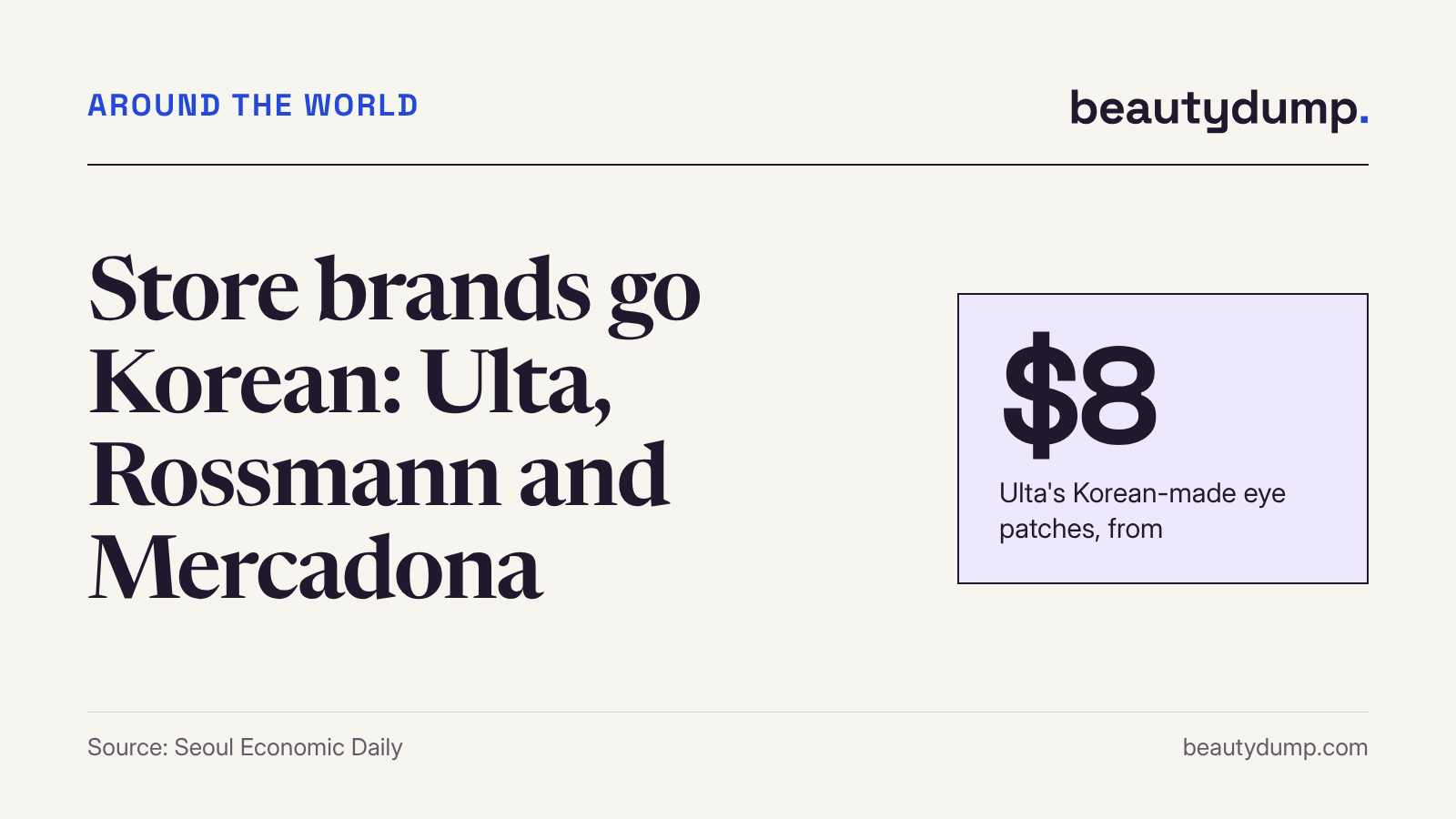
Big retailers outside Korea are no longer just stocking Korean brands; they are having Korean factories make skincare under their own labels, Seoul Economic Daily reports.
The paper lists several examples. Dutch and Belgian drugstore chain Kruidvat launched a "Korean Skincare" line of eight products in June. Germany's Rossmann added eight Korea-made products to its value brand Isana last year. Spain's Mercadona started with Korean-made PDRN and collagen eye patches in August and added a "K-Skin" range last month. In the US, Ulta sells Korean-made eye patches under its own Ulta Beauty Collection, starting at $8.
The work goes to contract manufacturers such as Cosmax, Kolmar Korea and Cosmecca, which make products for many brands. The paper puts their export revenue at between 1.7 and 2.5 times 2022 levels last year, and says Cosmecca and Cosmax are both spending on new factory capacity.
Where we agree: the factories behind many famous K-beauty brands are also the ones making these lines, so a store-brand eye patch can be well made. That's a fair reason to try the cheaper option.
Where we'd be careful: a shared factory doesn't mean a shared formula. Each customer specifies its own ingredients and concentrations, so compare the ingredient list, not the country of origin. And price per patch matters more than the sticker. An $8 pack only beats a branded one if it holds a similar count. For comparison, here's what a branded Korean hydrogel eye patch costs across the US stores we track today:

Sources
- Seoul Economic Daily (Nov 16, 2026)